Bonn Climate Change Conference 2026 / Week One Article 6 Digest
A briefing on Week One of the Bonn Climate Change Conference 2026 from the Article 6 Observatory on the ground.

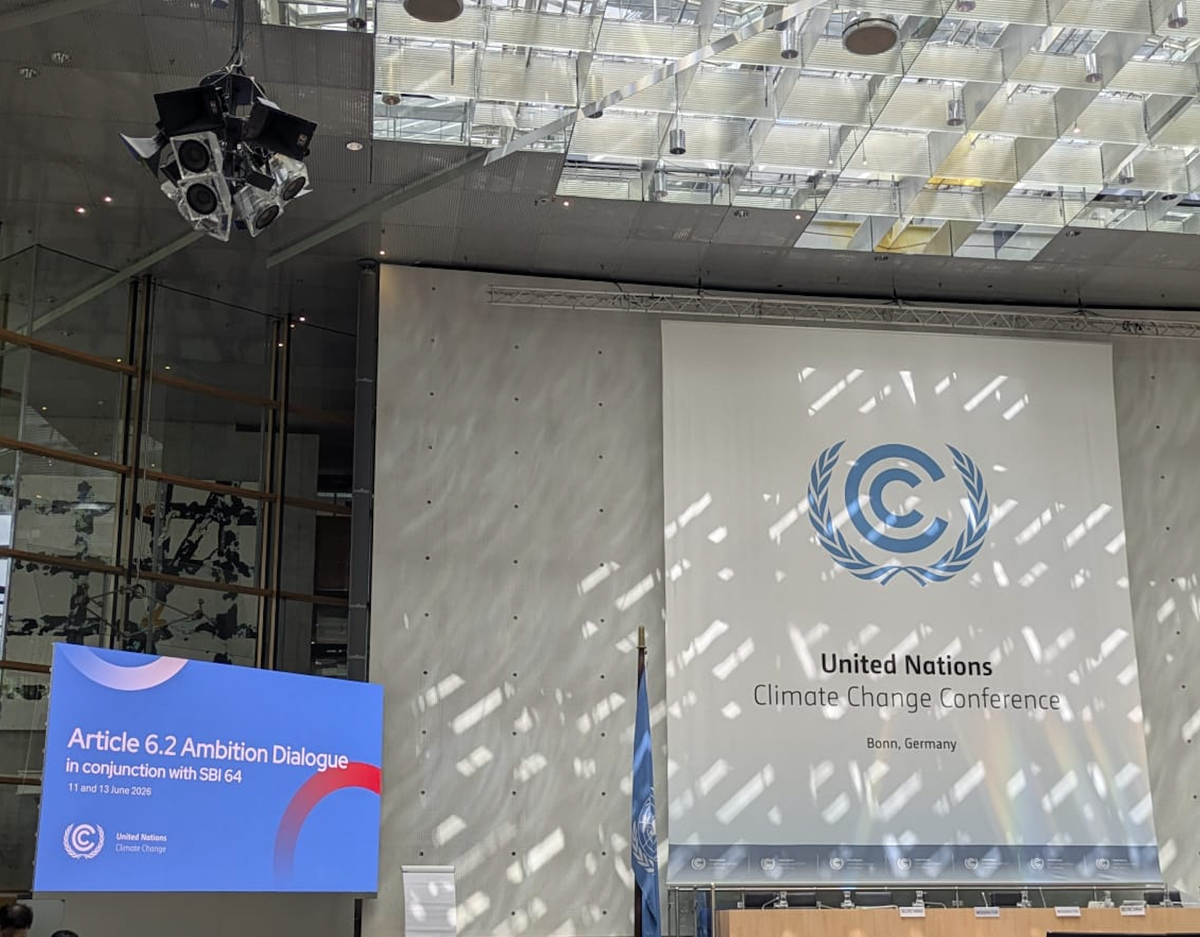
The official UNFCCC Article 6 agenda for Week 1 of SB64 included an all-day Article 6 event hosted by GIZ on 8th June; negotiations on funding arrangements under SBI agenda item 17 throughout the week; mandated Ambition Dialogues convened on 11th and 13th June 2026; and a PACM side event that took place on 12th June.
Article 6.2: Cooperative Approaches
Week One deliberations under Article 6.2 focused almost exclusively on arrangements for funding core technical infrastructure, expert review processes as well as capacity building activities required for implementation of cooperative approaches.
Latest documents:
- Draft text on arrangements for funding infrastructure, processes and capacity-building for implementing the guidance on cooperative approaches referred to in Article 6, paragraph 2, of the Paris Agreement (12.06.2026)
- Informal note on arrangements for funding infrastructure, processes and capacity-building for implementing the guidance on cooperative approaches referred to in Article 6, paragraph 2, of the Paris Agreement (13.06.2026)
Article 6.2’s Funding Gap
Parties considered an updated Secretariat technical paper examining options to address an estimated funding shortfall of approximately €8–9 million through 2027. Discussions revealed broad agreement that stable and predictable financing is urgently required, but significant disagreement remains over how such financing should be generated. The clearest fault line concerned whether Article 6 infrastructure should be treated as a global public good or financed, at least partially, through user-based approaches. Developing country groups consistently argued that financing arrangements should not create new barriers to participation, while several developed countries expressed interest in self-financing models. AGN repeatedly stressed that many developing countries are dependent on international infrastructure, particularly the international registry, and warned that funding delays could restrict participation.
The co-facilitators circulated an informal note and draft conclusions which would:
- note the updated technical paper;
- recognise the existence of a significant funding gap;
- invite voluntary contributions;
- request additional Secretariat reporting; and
- continue consideration of the matter at SBSTA 65 (COP31)
The LMDCs, Arab Group, LDCs, AOSIS, AILAC and AGN broadly favoured voluntary contributions, trust-fund approaches, continued public financing; and protection against additional participation costs. AILAC warned that user fees could “limit or exclude” participation by some countries. AOSIS stressed that Parties not participating in Article 6.2 should not bear costs associated with cooperative approaches.
The UK, Switzerland and parts of the EU intervention expressed openness to user fees; transaction-based fees; trust-fund mechanisms; and broader self-financing approaches. Switzerland argued that charging entities benefiting from registry services was: “straightforward and fair.” The UK suggested that voluntary contributions alone are unlikely to provide a sustainable long-term solution.
No consensus emerged on whether user fees should be introduced, whether private entities should contribute to funding, the role of trust funds, prioritisation of infrastructure versus capacity-building expenditures; or how supplementary funding should be administered. Funding arrangements are therefore expected to remain a significant issue through SBSTA 65 and COP31.
Authorisation is becoming a strategic policy decision
In the Article 6.2 Ambition Dialogue several Parties described increasingly sophisticated domestic governance arrangements for authorisation decisions. Zimbabwe, Madagascar and Kenya highlighted efforts to integrate NDC planning, registry systems, authorisation frameworks and sustainable development objectives. Overall illustrating that authorisation decisions are increasingly viewed as strategic national policy choices rather than purely technical carbon accounting exercises.
Managing overselling risks
A recurring concern concerned balancing carbon market participation against future mitigation needs. Many Parties described efforts to establish export ratios, develop carbon budgets, align authorizations with NDC implementation and preserve future mitigation options. Kenya, for instance, specifically highlighted challenges associated with determining how much mitigation can safely be transferred while still achieving national climate goals.
Increasing integration with NDC cycles
Several speakers noted that Article 6 considerations are increasingly being integrated into broader NDC planning processes. The EU highlighted its proposal to allow limited use of high-quality international credits from 2036 onwards while maintaining alignment with Paris Agreement objectives. Broad agreement emerged that institutional arrangements matter; authorisation processes must be transparent; capacity building remains essential; reporting systems require further support; and Article 6 participation should support, rather than undermine, NDC implementation.
Environmental Integrity
A central area of convergence on the second part of the Ambition Dialogue on the 13th was that environmental integrity cannot be treated as a narrow accounting exercise. Switzerland described a highly scrutinised, project-by-project approach, relying on internal governmental assessment and external technical expertise before authorising activities. The EU, speaking as a “constructive observer”, argued that corresponding adjustments alone are insufficient and that Parties must also demonstrate how cooperative approaches avoid over-crediting, lock-in, weak baselines, non-permanence and inconsistency with NDC and LT-LEDS pathways. Several speakers pointed to emerging tools under the Paris Agreement Crediting Mechanism, Article 6 Academy capacity-building work, rating frameworks and evolving voluntary-market practice as possible reference points for Article 6.2.
Prescriptiveness of Reporting
However, there was no agreement on how prescriptive Article 6.2 should become. The EU and environmental observers argued that greater prescription and clearer reporting expectations are needed, particularly on baseline setting, additionality, permanence, safeguards and “no net increase” in emissions within and between NDC periods. LMDC and others cautioned against overburdening implementation or constraining the diversity that Article 6.2 was designed to allow. The A6 Implementation Partnership emphasised continuous improvement and the need to reduce reporting burdens, while AGN stressed that Parties should not rush initial reports before domestic institutional arrangements and robust standards are in place.
Treatment of Inconsistencies
The treatment of inconsistencies identified through Article 6 technical expert reviews was also discussed. AGN as well as several observer constituencies argued that Parties should not buy, sell or use ITMOs from approaches with significant inconsistencies, particularly where these relate to environmental integrity, human rights, public participation or permanence. Switzerland and Palau, as well as the non-Party stakeholder Article 6 Implementation Partnership, cautioned against treating every inconsistency as proof of a defective activity, arguing that many findings may reflect weaknesses in reporting rather than in the underlying cooperation. The EU took an intermediate position: inconsistencies are serious and need to be unpacked, but causes may include unclear guidance, weak buyer–host coordination, lack of methodological ownership by host Parties, or insufficient support during reporting.
Project level vs National Assessments
Several participants identified a gap between project-level assessment and national-level NDC alignment. CFRN questioned whether environmental integrity can be demonstrated fully at project level, particularly where multiple activities interact with national accounting and reversal risks. The EU similarly highlighted that the absence of a clear definition of “cooperative approach” complicates aggregation and review. The A6IP and the EU both called for clearer interpretation of “no net increase” in emissions, noting that reviewers themselves may not apply the concept consistently.
Areas Missing from Article 6.2
Observers broadened the discussion beyond carbon accounting. ENGO, YOUNGO, IPO and TUNGO stressed that ambition must include human rights, Indigenous Peoples’ rights, FPIC, grievance mechanisms, labour rights, benefit sharing, public accessibility of information and safeguards against mitigation deterrence. IPO argued that Article 6.2 cannot be considered high ambition if ITMOs are well tracked but harmful on the ground. TUNGO added that carbon-market integrity discussions rarely recognise workers whose labour underpins project implementation. YOUNGO stressed that without environmental integrity, for example in the case of non-permanence, future generations will bear the burden.
The Ambition Dialogue closed with broad support for its continuation but suggestions for more structured exchanges, breakout discussions, better use of lessons from review reports, a synthesis of recurring inconsistencies, and clearer separation between discussions on implementation and ambition. The Secretariat invited written feedback through a survey to inform future dialogues, including those around SB65.
Article 6.8: Non-market Approaches
Negotiations under Article 6.8 focused on two interrelated issues:
- The review of the work programme under the framework for non-market approaches (NMA); and
- Consideration of additional functionalities for the NMA Platform, including potential linkages with projects identified under the Sharm el-Sheikh Mitigation Work Programme.
Latest documents:
- Meeting of the Glasgow Committee on Non-market Approaches. Draft conclusions proposed by the Chair
- Draft text on matters relating to Article 6, paragraph 8, of the Paris Agreement Meeting of the Glasgow Committee on Non-market Approaches (11.06.2026)
- Draft text on matters relating to Article 6, paragraph 8, of the Paris Agreement. Review of the work programme under the framework for non-market approaches referred to in Article 6, paragraph 8, of the Paris Agreement and in decision 4/CMA.3 (12.06.2026)
- Matters relating to Article 6, paragraph 8, of the Paris Agreement Review of the work programme under the framework for non-market approaches referred to in Article 6, paragraph 8, of the Paris Agreement and in decision 4/CMA.3 (13.06.2026)
Overall a number of themes emerged throughout Week One in relation to Article 6.8.
Strong support for improving implementation
Many Parties recognised the value of the work programme and supported efforts to improve the functionality of the NMA Platform. There was broad interest in improving its visibility and matchmaking functions to enable the mobilisation of support, stronger coordination with other related initiatives and better use of national focal points.
Questions about the practical value of the platform
At the same time, a recurring theme was concern that the platform currently functions primarily as a repository of information rather than an implementation tool. Several interventions questioned the practical value of project registration and whether the platform’s functionalities adequately support implementation.
Support for enhanced functionality
Several Parties, such as Brazil and the Philippines highlighted opportunities for greater visibility, improved access to support and stronger information sharing. The Philippines emphasised accessibility, transparency and voluntary participation.
Caution regarding scope
The EU stressed that discussions should focus on the possibility of linkages rather than immediate integration of projects. Several Parties questioned the practical benefits of linking Mitigation Work Programme projects to the NMA Platform. Agreement has not been reached on this as well as other issues related to the purpose and design of additional platform functionalities, the value of Mitigation Work Programme linkages and how implementation support should be operationalised.
Contestation over spin off discussion topics and scope
A number of topics for spin-off discussions revealed continued debate regarding the future direction and scope of the Article 6.8 work programme. This included, ecosystem protection and restoration, clean energy development, transition away from fossil-fuels subsidies; and responses to carbon border adjustment measures.
This range prompted disagreements concerning the boundaries of permissible discussion under Article 6.8. LMDCs argued that issues such as energy sources, subsidies and food security are nationally determined matters falling outside the mandate of the work programme. Switzerland took the opposite view, arguing that such discussions remain legally permissible within the framework. Following consultations, the Secretariat indicated that Parties remain free to discuss: “causes of climate change, and development of clean energy resources” within spin-off groups.
Growing interest in single-country NMAs
CfRN and LMDCs expressed support for recognising single-country NMAs. This issue continues to emerge as a significant point of discussion regarding the future evolution of the framework, as there is no consensus among Parties as to the role these could play within the framework of Article 6.8.
Overall Outlook
Week One at Bonn demonstrated that Article 6 negotiations have moved decisively into an implementation phase. The architecture is largely established, but Parties are now confronting more difficult questions relating to financing, institutional readiness, environmental integrity and long-term ambition. Parties seem to already be preparing their wish lists for the Article 6 review in 2028. While there is broad agreement that Article 6 is now operational, there remains substantial disagreement over how the system should be financed, governed and scaled in the years ahead.